

Big Daddy Davos
Our two leaders and their World Economic Forums

Last year, I had the good fortune of working on the Carney campaign alongside tremendously smart pollsters Rosalie Nadeau and Hilary Martin. The campaign was weird because we had very little lead time. The public didn’t know our candidate well, although his first impression was very good. We learned the components of Carney’s brand and how to reinforce it in real time. That’s not how it normally goes, but luckily, it worked.
When conducting political research, there are always moments when the candidate’s brand transforms from a 2-dimensional list of attributes to something with life. Often, these moments occur during focus groups when a participant says something so piercingly true that it shifts how we think about the race. In 2025, this moment happened out in the open.
My favourite moment of the 2025 campaign is when a woman heckled Carney with a “lead us big daddy!” which received a flustered, and maybe a little flattered, laugh from the PM. The exchange went viral. For me, it made the data real. “Big Daddy Carns” became our often-joked-about shorthand for the PM’s specific flavour of cheeky/charming competence. It’s Business Carney, but it’s also the alter ego who pocketed a beer at a St Patty’s Day parade, bragged about his Spotify age, and made jokes about cabinet selections. BDC is serious but fundamentally human.
The Prime Minister’s speech at the World Economic Forum was brand-perfect. Carney was exactly who we told voters he was and who they elected him to be. While there were no beers put into pockets, Big Daddy Carns made that speech. He was diplomatic, but firm. He also employed the much-overlooked political tactic of telling the truth.
I’ve written at length (here, here) about how the vast majority of Canadians view the Trump administration. 2 in 3 Canadians believe “fascism,” “authoritarianism,” or presumably a whole new, not yet defined “ism” apply to what is happening to American democracy. In his speech, Carney looked Canadians in the eye and said, “I see what you’re seeing. You’re not crazy, you’re not alone.” It’s reassurance through shared reality. He invited other leaders to join us in the light.
The empty calories of conspiracy
There’s something poetic about Carney’s presumably historic speech happening at the World Economic Forum, one of the villains of the Twittered right. If you’re unfamiliar with the WEF/Great Reset conspiracy theory, bless you. It argues that the global elite, led by the World Economic Forum, planned the pandemic to trigger economic collapse and establish a socialist world government. This is a conspiracy theory Pierre Poilievre was (and is) more than happy to take advantage of.
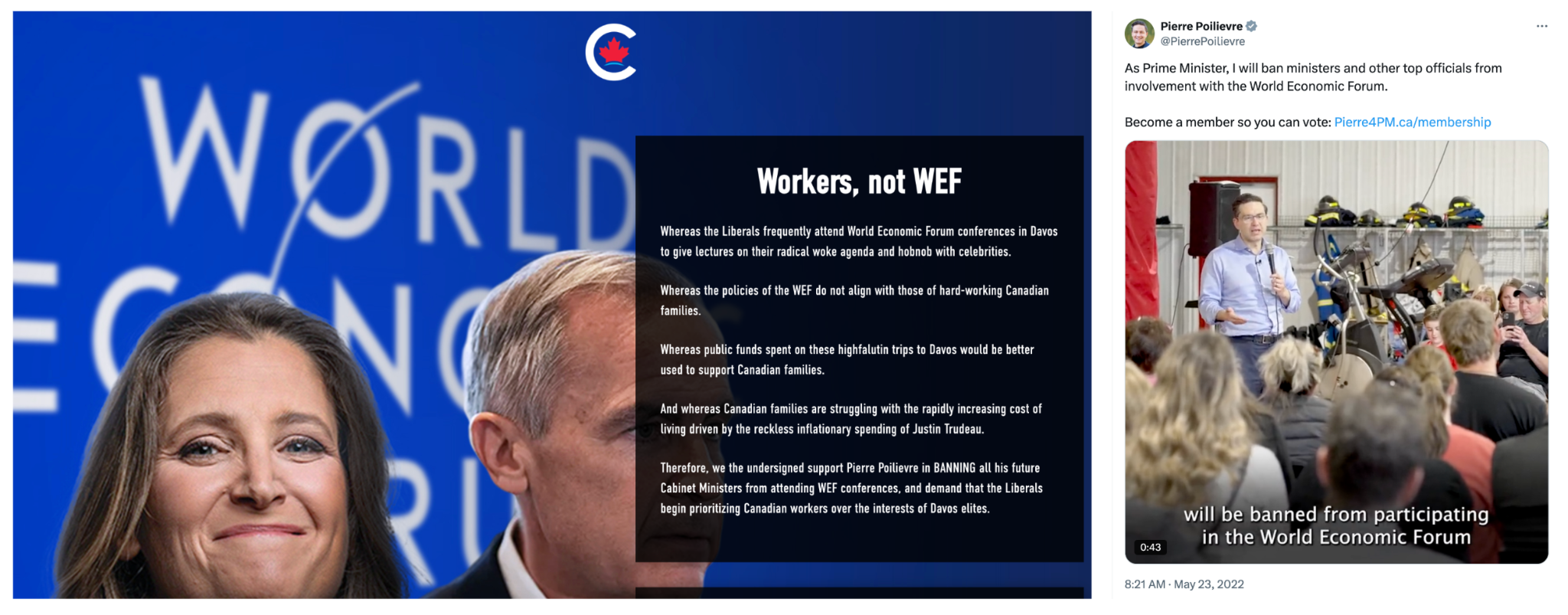
From the pandemic to Trump’s reelection, the political energy in the country was taken up by the “Fuck Trudeau” right. I don’t want to paint anyone who disliked Trudeau (there were many) with the same brush. I’m talking about the super-angry, super-online crowd who became both the victims and purveyors of misinformation. These are the people who supported the convoy, thought COVID was a hoax, and bought into the Great Reset theory.
When Donald Trump started threatening our sovereignty, a new, more dominant source of political energy emerged. It was driven by Canadians, disproportionately seniors, who are deeply disturbed by what they’re seeing south of the border. It’s not that anti-elite backlash disappeared overnight; it’s still there. But for most Canadians, the greatest outside threat to our country is Donald Trump and his MAGA goons, not faceless elites who want action on climate change.
Political energy is the fuel of campaigns, but, as with food, some sources are better than others. Speaking only to the hyper-online is persuasion candy. It provides a quick hit, but lacks longevity. In prioritizing the conspiratorial minority of his base, Poilievre sacrificed broader appeal. This leads us to where we are today.
Carney’s greatest advantage over Poilievre is his WEFian skillset: representing Canada on the world stage, navigating global conflicts, and bringing Canadians together. However, Carney also wins in a forced-choice on domestic issues, including dealing with the cost-of-living crisis and Alberta and Quebec separatism.
Poilievre peddling conspiracies is part of what leads 51% of Canadians to believe (28% strongly) that he “represents a scary kind of politics.” This view is widespread among those who are not Conservative voters. As I wrote in November, this is especially problematic in the politically polarized moment we’re living in. As a point of reference, 25% of Conservative voters strongly believe Carney is “scary.”
In the face of Trump’s instability, Canadians are acutely aware of our need to build relationships, work with allies, and supplement the US as a trading partner. It requires diplomacy at venues like the World Economic Forum. I’m sure there’s little Poilievre wouldn’t give to be seen as someone who could get a standing ovation at Davos. He should have stayed away from the sweets.
I think Carney's speech yesterday buried any hope that Poilièvre has of ever becoming the Prime Minister. I can't even imagine him giving this kind of speech.
I was immensely proud to be a Canadian yesterday.
Find it very irritating that people are negative about P.M.Carney .so fortunate he decided to step up.